Charge Controllers
What is a charge controller, and do I need one.
The primary purpose of a charge controller is to prevent battery overcharge. For all but the smallest of systems, a charge controller is a very important piece of equipment. Unless your charge sources are quite small, or your battery bank is very large, you need a charge controller. You may elect not to use a controller if your incoming energy is in the range of 2 watts / 50 amp-hours of battery capacity (trickle charge / maintenance). Generally speaking, you need a charge controller or you can expect to replace your batteries often.
Second in importance is additional charging algorithms to help insure battery longevity and health: bulk, absorption, float, equalize. Third is to maximize the energy your charge sources are creating and matching them to your batteries.
Charge controllers fall into these categories, in order of complexity and capability:
- 1 or 2 stage controllers
- 3 stage or PWM controllers
- MPPT (Maximum Power Point Tracking) controllers
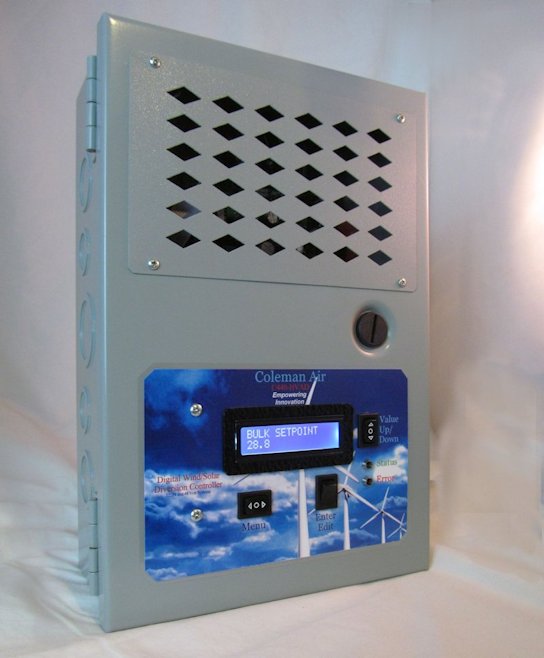
1 or 2 Stage controllers. Also referred to as single or dual voltage charge/diversion controllers. These generally rely on a relay or set of relays to disconnect or divert an energy source or load when the battery voltage reaches a certain point. They can range from a few amps to hundreds of amps and are often limited only by the capacity of the relays they are switching. They do not offer battery maintenance charging (such as equalize) as they simply monitor the battery voltage and "trip" at a certain level. They can be very economical and very reliable as they are simpler in nature.
Who should consider this type of controller:
- You have or will have a wind or hydro energy source. This type of controller can be wired as a diversion controller so the turbine stays fully loaded.
- You have a solar only system but your budget does not allow a more advanced controller.
- You have a more advanced controller for normal conditions, but you also have a wind generator and need an insurance policy against overcharge in high wind.
- You have a backup generator that is manually started and not controlled by the inverter.
Who should NOT consider this type: You do not have a wind or hydro turbine and have a sufficient budget to purchase a more advanced controller, and all charge sources can be routed through your PWM/MPPT controller.
Multistage, 3 stage or PWM controllers. PWM (Pulse Width Modulated) controllers are solid state and offer more advanced charging algorithms. As battery voltage increases, the controller restricts incoming voltage and current. It does this via pulses of energy that may last from less than a second to several minutes (pulse width modulation). These pulses can be better for battery plates than a steady high voltage D/C charge.
Three stage charging:
- Bulk: Most of the available current is sent to the batteries until they reach about 80% capacity. Generally 13.5 to 15 volts on a 12 volt bank.
- Absorption: A slightly higher voltage to finish the charge. For a 12 volt lead acid battery, typically 14.2 to 15.5 volts. Gassing is normal and required to complete the chemical reactions.
- Float: Maintains the batteries at about 13 to 13.2 volts (flooded 12 volt lead acid) by applying pulses of current as required.
Equalize is not part of the normal cycle. It is initiated manually (~10% higher voltage) to mix electrolytes and equalize a multi-battery bank. Typically every 10 to 40 days for 2 to 16 hours.
Well made three stage controllers are recommended for solar only installations, or solar and wind if the controller can also run in diversion mode. If you have a wind turbine, insure the controller can run in diversion mode; wind turbines must have a load at all times.
MPPT controllers. These are the most advanced controllers available and may offer 10 to 20 (some tests claim 30) percent more efficiency, at a heavy financial price. The debate is often: add 20% more solar panels and use a traditional controller, or pay for MPPT. MPPT controllers are designed for solar; at the time of the original article there was not a MPPT controller designed specifically for wind.
To charge a battery the charge voltage must exceed the battery voltage. A standard 12 volt lead acid battery requires around 15 volts to finish the charge, so the panel must put out at least that. Because panels are rated at 25 C, and because of wire, diode and connector losses, panels typically start with an open circuit voltage of at least 18 volts (often 17-18 Vmp, up to ~24 Voc). When you hook the panel to the battery, the battery drags down panel voltage below the maximum power point. MPPT electronics (transformers and tracking algorithms) convert excess voltage to amperage and continuously track the maximum power point.
MPPT is recommended for solar systems in cold climates and where batteries are drawn down by constant loading and you do not wish to add panels. MPPT is not recommended as the wind controller; use a diversion controller for wind/hydro and MPPT for solar if both are present.
Conclusion: Wind based systems should consider economical relay-based single stage controllers, or PWM designed for wind and/or wind/solar. Solar only systems should consider PWM, and MPPT if required by the panels (some panels have a very high VOC). PWM controllers are by far the most popular controllers being used today for alternate energy systems.
Source: getawaypower.com/2019/01/charge-controllers/